


Views: 0 Author: Site Editor Publish Time: 2026-03-26 Origin: Site


What happens when one gap becomes many? Eating gets harder than most expect.An Implanting Bridge can restore that space. It replaces several teeth in one fixed solution.In this article, you will learn its purpose. You will also see when it is the right choice.
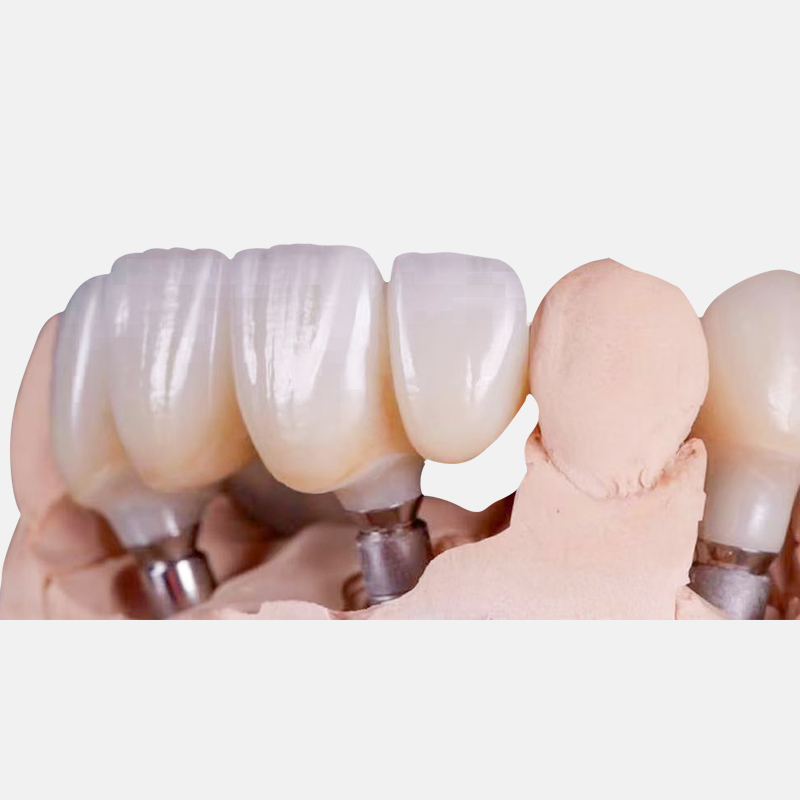
An Implanting Bridge is mainly used to replace several missing teeth in one row, or in some cases several spaced missing teeth, without depending heavily on neighboring natural teeth for support. In many clinical situations, it uses one to four implants placed in the alveolar bone as artificial abutments, and then connects custom bridge crowns to create a stable, non-removable restoration. This makes it especially useful when two to six teeth are missing and the patient wants a fixed solution rather than a removable denture.
Its first major use is restoring chewing function after tooth loss. When several adjacent teeth are gone, the patient often avoids chewing on that side, which can reduce comfort and change bite habits over time. An Implanting Bridge helps bring back stable biting surfaces, so food can be chewed more evenly and comfortably. This matters even more in posterior areas, where the bite load is higher and the loss of multiple teeth can strongly affect daily eating.
It is also used to rebuild the smile without relying on a removable appliance. Some patients want a fixed restoration because they dislike the movement, bulk, or daily removal involved in partial dentures. An Implanting Bridge stays in place and generally feels more secure, which can improve both function and confidence.
Another important use is protecting adjacent healthy teeth. A traditional tooth-supported bridge often requires preparation of the teeth next to the gap, even if they are healthy. An Implanting Bridge, by contrast, is supported by implants, so it often preserves more natural tooth structure. That is one reason many dentists recommend it when several teeth are missing but the neighboring teeth are still strong.
It can also improve speech and daily comfort. When front or premolar teeth are missing, pronunciation may change, and the gap may affect airflow during speaking. Replacing those teeth with a fixed bridge can help restore clearer pronunciation and better oral stability.
Finally, an Implanting Bridge helps maintain jawbone support in the missing-tooth area. Since implants are placed into bone, they can help provide the kind of stimulation that is lost after extraction. A conventional bridge fills the space above the gum, but it does not replace the tooth root. An Implanting Bridge offers support below the gum as well, which is one reason it is often seen as a more complete solution for multiple tooth loss.
Common Use of an Implanting Bridge | Why It Matters |
Replacing multiple adjacent missing teeth | Restores a longer gap with a fixed design |
Replacing spaced missing teeth in some cases | Offers flexibility when case planning allows |
Improving chewing efficiency | Helps patients bite and eat more comfortably |
Avoiding a removable denture | Provides more stability and convenience |
Protecting healthy adjacent teeth | Reduces the need for tooth preparation |
Supporting jawbone in missing areas | Helps maintain structure after tooth loss |
An Implanting Bridge works by using dental implants as the foundation for a fixed bridge. The implants act as artificial tooth roots, and once they are placed into the jawbone, they support the bridge above the gumline. This is the key structural difference between an implant-supported bridge and a traditional bridge. A conventional bridge depends on natural teeth at each side of the gap. An Implanting Bridge depends on implants instead.
One practical advantage is that fewer implants can support more teeth. In many cases, two implants may support a three-unit bridge, while a larger gap may be restored by placing more implants to carry a longer bridge. That means the patient does not always need one implant for every missing tooth. This can make the treatment more efficient while still delivering stable function.
However, the bridge cannot be fitted immediately in most routine cases. After the implants are placed, they need time to heal and integrate with the surrounding bone. This biologic process is called osseointegration. It is what gives the implant long-term stability. Without it, the bridge would not have a secure base for chewing and daily function.
The design of the final restoration also matters. Some Implanting Bridge cases use monolithic zirconia for strength and simplicity, while others use a layered zirconia design for improved esthetics in visible areas. In more demanding full-arch cases, a digital titanium bar may be added beneath the bridge for extra support and passive fit. These design choices show that an Implanting Bridge is not just a fixed row of teeth. It is a carefully engineered prosthesis that balances structure, esthetics, hygiene, and force distribution.
JGQ Dental Lab presents this clearly in its product profile. Its digital full-arch zirconia Implanting Bridge solutions use high-translucency zirconia, titanium alloy, and Co-Cr alloy options, with framework designs that include CAD/CAM-milled titanium bars or monolithic zirconia. This kind of versatility matters because different cases place different demands on the final restoration.
A good Implanting Bridge candidate is usually someone missing multiple adjacent teeth and looking for a fixed alternative to removable treatment. This option is especially common when the gap is too large for a simple single crown restoration, but the patient still wants a result that feels stable and functions like a fixed part of the mouth.
Healthy gums and good oral hygiene are important. Even the best implant bridge can fail if the surrounding tissues are not healthy or if plaque control is poor. Before treatment begins, the dentist will usually assess gum condition, oral hygiene habits, and the patient’s willingness to maintain regular follow-up care.
Adequate bone support also matters. Since implants must be placed into the jawbone, the clinician needs enough bone volume and density to support them. If bone loss has already occurred, grafting or staged preparation may be recommended first. This does not automatically exclude a patient from treatment, but it may extend the planning and healing timeline.
Adults who want a fixed replacement instead of a denture are also common candidates. They often prefer the stability, appearance, and daily comfort of an Implanting Bridge, especially if they have struggled with denture movement or dislike removing their prosthesis each day. At the same time, not every patient is a perfect immediate candidate. Smoking, uncontrolled diabetes, heavy grinding, or complex bite problems may require more careful evaluation.
From a lab perspective, good candidacy matters as well. A high-precision bridge cannot compensate for poor implant positioning, unstable tissues, or incomplete planning. That is why the best outcomes come from strong communication between clinic and lab, supported by accurate digital records and realistic case design.
An Implanting Bridge is often compared with three other options: a traditional dental bridge, a partial denture, and individual implant crowns. Each option has value, but they solve different problems.
Compared with a traditional bridge, an Implanting Bridge usually preserves more natural tooth structure because it does not rely on neighboring teeth as the main support. This can be a major advantage when the adjacent teeth are healthy and should not be prepared unless necessary. It may also provide better long-term bone support because implants replace the missing roots, while a traditional bridge does not.
Compared with a partial denture, an Implanting Bridge is generally more stable and more comfortable during chewing. A removable denture may shift, trap food, or feel bulky. An Implanting Bridge remains fixed in place, which many patients find easier to live with in daily life.
Compared with individual implant crowns, a bridge can be more efficient when several teeth in one area are missing. Instead of placing one implant for every missing tooth, the dentist may use fewer implants to support a multi-unit bridge. This can simplify some cases and reduce surgical complexity while still restoring the whole gap.
The best option depends on gap size, bite force, budget, esthetic demands, and bone availability. A short gap with two missing teeth may be handled differently from a long posterior span or a full-arch restoration. That is why case selection should always guide treatment choice rather than habit alone.
Option | Main Support | Key Advantage | Main Limitation |
Implanting Bridge | Dental implants | Fixed support for several missing teeth | Longer treatment time |
Traditional Bridge | Natural adjacent teeth | Faster in some cases | Requires tooth preparation |
Partial Denture | Gums and clasps | Lower initial cost | Less stable and removable |
Individual Implant Crowns | One implant per tooth | Independent tooth replacement | More implants may be needed |
The treatment process for an Implanting Bridge usually begins with an exam, imaging, and treatment planning. The dentist reviews the patient’s oral condition, bite, gum health, and bone level. X-rays or 3D scans are often used to plan implant position and bridge design more accurately.
Next comes implant placement surgery. The number of implants depends on the size and shape of the missing area. In some cases, the patient may need extraction or bone grafting before the implants are placed. Once surgery is complete, healing begins. This stage is critical because the implants need time to integrate with bone before the final bridge is loaded.
During healing, a temporary prosthesis may sometimes be used, especially in visible areas or full-arch cases. This helps protect appearance and function while the implants stabilize. After healing, the final impression or digital scan is taken, and the bridge is designed and fabricated.
This is where digital manufacturing becomes especially important. JGQ Dental Lab positions itself as a digital outsourcing partner for dental labs and clinics, and its Implanting Bridge workflow accepts STL, PLY, DCM, or even physical impression models. That flexibility helps support both modern digital practices and more traditional workflows. The company also states that its restorations are fabricated with precision CNC milling, 3D laser printing, and digital casting, using German and Japanese CNC machines to achieve micron-level tolerances. For clinics and labs, this matters because more accurate fit can reduce chairside adjustment and improve delivery efficiency.
Once the final bridge is ready, it is fitted and secured, often as a screw-retained design in full-arch cases. The dentist then checks fit, bite, esthetics, and hygiene access before finalizing the restoration.
A well-planned Implanting Bridge offers several clear benefits. One is strength and stability. Since it is implant-supported, it usually feels more secure than a removable option, which can improve chewing confidence and reduce movement during function.
Another benefit is tooth preservation. Because the bridge does not need to depend mainly on neighboring natural teeth, it often avoids the preparation required by a traditional bridge. This can be valuable when adjacent teeth are healthy and worth preserving.
It also supports bone and facial structure better than solutions that do not replace the roots. Implants help maintain support in the missing area, which may reduce the collapse that can happen after long-term tooth loss. This is especially relevant in larger spans and full-arch restorations.
A further benefit is efficiency. For multiple missing teeth, an Implanting Bridge may provide a more efficient solution than placing one implant for every missing tooth. It combines implant independence with bridge efficiency, which is one reason it is widely used in modern restorative planning.
JGQ Dental Lab also highlights several product-level advantages that fit naturally into this discussion. Its Implanting Bridge solutions use layered zirconia with reported flexural strength of 1200 MPa, solid zirconia polished for plaque resistance and reduced wear on opposing teeth, and optional digital titanium bars to improve full-arch strength and stability. The lab also emphasizes screw-retained hybrid prostheses and full-arch zirconia restorations as ways to reduce issues such as acrylic fractures, prosthesis popping out, or excessive wear seen in some removable designs.
An Implanting Bridge has clear benefits, but it also has limitations. The healing process is usually longer than with a traditional bridge because implants need time to integrate before the final restoration can be placed. This means the treatment often takes months rather than weeks, depending on the complexity of the case.
Cost is another consideration. Pricing depends on the number of implants, the number of bridge units, the material used, the need for grafting, and whether the case is a short-span or full-arch restoration. That is why it is better to explain cost drivers than to promise one standard price. In clinical and lab settings, more advanced designs, premium zirconia, titanium bar reinforcement, and digital smile planning may all affect final cost.
Not every patient is an immediate candidate. Poor bone support, active gum disease, uncontrolled habits, or limited hygiene ability may require extra care or an alternative plan. These issues do not always rule out treatment, but they do affect how predictable the final result will be.
Long-term care is essential. Patients need to brush carefully, clean beneath the bridge where possible, attend regular checkups, and report loosening, discomfort, or gum problems early. A fixed bridge is not maintenance-free. It is simply maintained differently from a removable appliance.
From a buyer’s viewpoint, long-term care also includes supplier support. JGQ Dental Lab states that its Implanting Bridge products are Class II medical devices with ISO 13485, CE, and FDA certifications, and that it provides a 3-year warranty, online technical support, and return or replacement service. These details matter in a B2B context because they reduce sourcing risk and support more confident case management.
An Implanting Bridge replaces several missing teeth with fixed, stable support.
It improves chewing, appearance, and daily comfort while protecting nearby healthy teeth.It also depends on precise design, strong materials, and smooth digital production. These factors shape fit, function, and long-term clinical value.Shenzhen Lezy Jumei Dental Medical Co., Ltd. adds value through CAD/CAM precision, reliable zirconia solutions, and flexible lab support.
A: An Implanting Bridge is a fixed restoration that replaces several missing teeth using dental implants for support.
A: An Implanting Bridge is used to restore chewing, speech, and appearance when multiple teeth are missing.
A: An Implanting Bridge feels more stable, stays fixed, and often protects daily comfort better.
A: Cost depends on implant number, bridge size, materials, and whether bone grafting is needed.


