


Views: 0 Author: Site Editor Publish Time: 2026-08-24 Origin: Site


The absence of a periodontal ligament in implant-supported prosthetics removes natural shock absorption. This makes occlusal overload a primary reason for catastrophic failure in full-arch rehabilitations. Achieving and maintaining balanced occlusal contacts is difficult in rigid, full-arch restorations. Imprecise force distribution leads to screw loosening, framework fracture, porcelain chipping, and peri-implant bone loss. Long-term success requires strict attention to biomechanics. This guide evaluates the hardware choices, digital impression protocols, provisional testing phases, and occlusal design frameworks necessary to engineer and maintain a stable Malo bridge. We will look at how to manage forces, select the right abutments, and execute a precise digital workflow. You need a reliable protocol to prevent off-axis loading and protect the implant-abutment interface from excessive stress.
Passive Fit is Non-Negotiable: Balanced occlusion cannot exist without a perfectly passive fit, requiring strict adherence to a precise scan body full arch workflow.
Hardware Dictates Force Distribution: Utilizing the correct multi unit abutment for Malo bridge cases ensures optimal trajectory correction and minimizes stress on the implant-abutment interface.
Framework Rigidity Prevents Flexure: A milled titanium base full arch bridge provides the necessary structural rigidity to prevent micro-flexure under heavy occlusal loads, protecting individual ceramic crowns.
Specific Occlusal Schemes are Required: Implant prosthetics demand shallow cuspal inclinations, precise anterior guidance, minimized cantilever loading, and objective digital measurement to prevent off-axis forces.
The biomechanical baseline of implant-supported prosthetics differs fundamentally from natural dentition. Natural teeth rely on a complex suspension system that allows for physiological adaptation under load. Implants are ankylosed directly into the alveolar bone. Success in a Malo bridge restoration requires engineering an environment where rigid structures can withstand dynamic, multi-directional masticatory forces. You must prevent these forces from transferring destructive stress to the osseointegrated interface or the restorative materials.
Natural teeth exhibit a physiological mobility of 10 to 50 microns due to the periodontal ligament. This ligament provides proprioceptive feedback, signaling the neuromuscular system to reduce bite force when encountering premature contacts. Osseointegrated implants lack this ligament. They exhibit a maximum mobility of only 3 to 5 microns, primarily due to surrounding bone flexure. This severe reduction in tactile sensitivity means patients cannot detect high spots on an implant prosthesis until a failure occurs. Hyper-accurate occlusal adjustments are mandatory to prevent premature contacts from bearing the entire load of the masticatory cycle.
Unbalanced occlusal forces act as a destructive lever against prosthetic screws. When a patient bites down on an uneven surface, the resulting off-axis loading creates a bending moment. Prosthetic screws rely on preload—the tension generated during torqueing—to keep the abutment and framework clamped tightly together. Continuous off-axis forces overcome this preload, causing the screw to stretch microscopically. Once preload is lost, the joint becomes unstable. Occlusal imbalance is the leading cause of screw loosening and subsequent screw fracture in full-arch cases. A screw torqued to 35 Ncm will rapidly lose its clamping force if the occlusal scheme forces the framework to rock during lateral excursions.
Full-arch implant rehabilitations often require posterior cantilevers to provide adequate chewing function, especially when anatomical limitations prevent distal implant placement. The physics of anterior-posterior (A-P) spread dictate the safe length of these cantilevers. The A-P spread is measured from the center of the most anterior implant to the distal aspect of the most posterior implant. Off-axis loading on distal cantilevers acts as a force multiplier. A heavy occlusal contact on a cantilevered pontic generates a massive tipping force on the most distal implant and a corresponding tensile pull-out force on the anterior implants. Managing the occlusion on these extensions prevents hardware fatigue and crestal bone loss. We generally restrict cantilever length to 1.0 times the A-P spread in rigid frameworks to limit these destructive lever mechanics.
The force dynamics applied to a full-arch prosthesis vary drastically depending on the opposing arch. When opposing natural teeth, the rigid implant restoration faces an unyielding surface capable of generating maximum bite force. This requires highly wear-resistant materials and a perfectly balanced scheme. Opposing a conventional denture introduces a different challenge. The denture mucosa compresses, altering the occlusal contacts during function. Opposing another implant-supported prosthesis creates a completely rigid system with zero shock absorption. This bone-to-bone rigidity demands the highest level of precision in occlusal design to prevent material fracture.
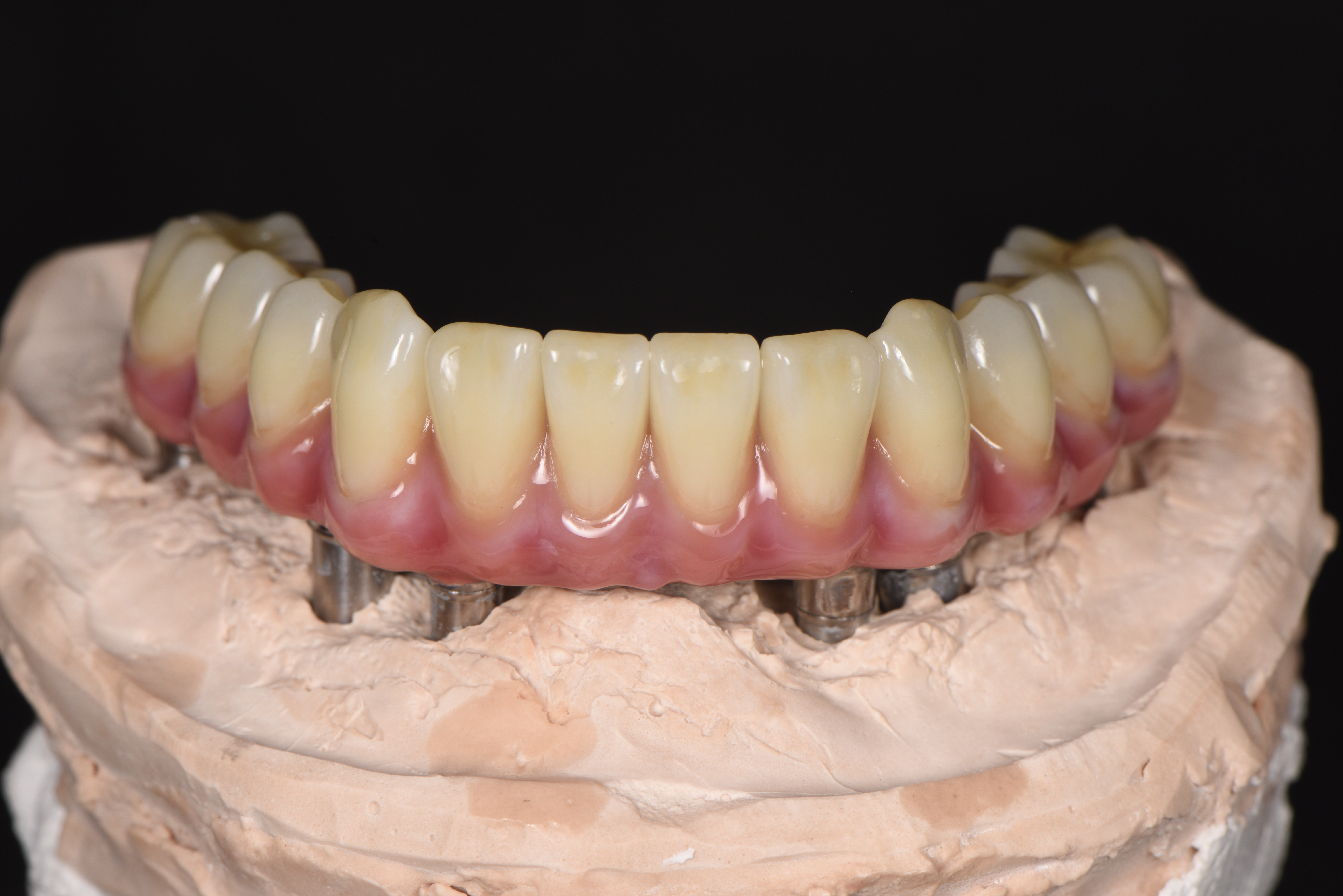
Intermediate abutments serve as the mechanical foundation for full-arch stability. Direct-to-fixture restorations often struggle with divergent implant angles, leading to compromised seating and built-in stress. Utilizing a dedicated multi unit abutment for Malo bridge cases elevates the restorative platform, standardizes the connection, and provides the necessary geometric correction to ensure the final framework seats completely passively.
Connection Types and Biomechanical Impact
Connection Strategy | Angle Correction Capability | Stress on Prosthetic Screw | Passive Fit Predictability |
|---|---|---|---|
Direct-to-Fixture (Internal Hex) | None (0 degrees) | High (absorbs lateral shear forces) | Low (prone to binding on insertion) |
Straight Multi-Unit Abutment | Up to 20 degrees divergence | Low (forces distributed to external cone) | High |
Angled Multi-Unit Abutment (17° / 30°) | Up to 60 degrees divergence | Low (forces distributed to external cone) | Very High |
Implants placed in the maxilla or mandible frequently follow available bone, resulting in divergent trajectories. Angled multi-unit abutments correct these divergences, aligning the prosthetic platforms to create a unified path of insertion. Forcing a rigid framework over divergent direct-to-fixture implants introduces massive internal stress. This internal binding mimics occlusal high spots, causing the framework to torque the implants constantly, even when the patient is not chewing. Proper trajectory correction eliminates this baseline stress, allowing the framework to drop into place without resistance.
Abutment selection directly impacts the biological width and peri-implant health. By moving the micro-gap of the restorative interface away from the crestal bone, multi-unit abutments utilize the concept of platform shifting. This prevents crestal bone resorption and promotes a robust mucosal seal. Maintaining stable crestal bone levels is a prerequisite for long-term occlusal stability. If bone is lost, the biomechanical fulcrum shifts apically, increasing the lever arm and magnifying the destructive potential of occlusal forces.
Multi-unit abutments convert the internal connection of the implant into an external cone optimized for splinted frameworks. This broad seating surface distributes lateral occlusal forces more effectively across the abutment body rather than concentrating them on the prosthetic screw. By moving the restorative interface above the tissue level, these abutments also facilitate easier visual and radiographic verification of passive fit. You can confirm that the framework does not rock or flex under load before finalizing the occlusion.
Digital impression accuracy dictates final occlusal balance. If the spatial coordinates of the implants are captured inaccurately, the resulting framework will not fit passively. A non-passive framework requires the clinician to torque the screws to force the bridge into place, immediately introducing static tension. This tension distorts the planned occlusal scheme, turning a perfectly designed digital occlusion into a clinical failure. The framework will constantly try to rebound to its resting state, pulling against the screws and the bone.
Executing an accurate scan body full arch workflow requires strict protocols. Standard intraoral scanners excel at single units and short spans but struggle with full-arch edentulous cases. The lack of distinct anatomical landmarks forces the scanner software to stitch multiple images together. Over a long span, these microscopic stitching errors compound, resulting in cross-arch distortion. When the lab mills a rigid framework based on distorted data, the prosthesis will rock, completely invalidating any occlusal adjustments made in the CAD software.
Evaluation of Data Capture Methods
Capture Method | Cross-Arch Accuracy | Workflow Efficiency | Risk of Distortion |
|---|---|---|---|
Traditional Intraoral Scanning (IOS) | Moderate to Low (prone to stitching errors) | High | High (without splinting or scanning aids) |
Photogrammetry (e.g., PIC, ICam4D) | Extremely High (sub-10 microns) | Very High | Minimal |
Analog Splinted Impression | High (technique sensitive) | Low (messy, time-consuming) | Moderate (stone expansion, material shrinkage) |
To eliminate cross-arch distortion, advanced data capture methods like photogrammetry are highly recommended. Photogrammetry uses specialized cameras to capture the exact spatial orientation of coded abutments in a single flash, bypassing the stitching algorithms of standard intraoral scanners. This guarantees that the digital master cast perfectly replicates the patient's oral geometry. The milled framework seats with zero tension, and the occlusal scheme remains exactly as designed in the laboratory.
Capturing the implants is only half the workflow. Capturing the vertical dimension of occlusion (VDO) and centric relation (CR) is equally important. Digital articulation requires scanning the opposing arch and capturing a highly accurate bite registration at the correct VDO. Clinicians must ensure the patient's condyles are fully seated in CR during the bite scan. Any deviation in the interocclusal record forces the laboratory to guess the spatial relationship, guaranteeing heavy occlusal adjustments at delivery.
Never proceed directly to final ceramics without a provisional testing phase. A milled PMMA prototype allows the clinician to verify the VDO, CR, aesthetics, and occlusal scheme in the patient's mouth. We follow a strict protocol for this phase:
Seat the PMMA prototype and hand-tighten the screws to verify passive fit using the one-screw test.
Check the vertical dimension of occlusion using facial proportions and phonetic tests (sibilant sounds).
Evaluate centric relation contacts with 200-micron articulating paper to identify gross interferences.
Adjust excursive pathways to ensure shallow anterior guidance and immediate posterior disclusion.
Allow the patient to wear the prototype for 4 to 6 weeks to test functional adaptation and neuromuscular comfort.
Adjustments are made directly to the plastic. Once the occlusion is stable and the patient is comfortable, the adjusted PMMA is scanned and used as the exact blueprint for the final restoration.
Framework materials dictate how occlusal forces are managed and distributed across the arch. Monolithic zirconia is highly aesthetic but extremely rigid and brittle. If occlusal forces are not perfectly balanced, monolithic zirconia is prone to catastrophic fracture. A segmented approach utilizing a metal substructure offers superior mechanical properties for managing heavy functional loads and protecting the underlying implants.
A titanium base full arch bridge serves as the gold standard for the Malo concept. Milled from a solid puck of Grade 5 titanium, this framework boasts a high modulus of elasticity and exceptional resistance to deformation. Under heavy occlusal loads, the titanium bar refuses to flex. This absolute rigidity is necessary because any micro-flexure in the framework will transfer stress directly to the overlying restorative materials or the underlying prosthetic screws, leading to component failure.
The true Malo bridge concept involves cementing individual crowns onto the rigid titanium framework. These crowns are typically fabricated from lithium disilicate, zirconia, or advanced composite materials. This segmented design offers significant biomechanical advantages over monolithic structures. By separating the teeth into individual units, the prosthesis mimics the natural arch. The titanium bar handles the gross structural loads and cross-arch stabilization, while the individual crowns handle the localized masticatory forces.
While the titanium framework provides rigidity, the choice of crown material can introduce a micro-level of shock absorption. Selecting slightly more resilient materials for the individual crowns, such as hybrid composites or specialized polymers, can partially compensate for the missing periodontal ligament. These materials absorb and dissipate a fraction of the occlusal energy before it reaches the titanium bar and the implants, reducing the overall stress on the system.
A primary advantage of the segmented titanium framework is stress shielding and repairability. If a patient experiences an unexpected occlusal overload, the damage is localized. An individual ceramic crown may chip or fracture, but the underlying titanium bar and the implants remain protected. The clinician can simply remove the damaged crown, take a quick intraoral scan of the titanium preparation, and mill a single replacement unit. This prevents compromising the entire arch's occlusal scheme or requiring a complete remake of the prosthesis.
Implant prosthetics require specific occlusal parameters that differ from natural teeth. The goal is to direct forces along the long axis of the implants while minimizing lateral shear forces. Horizontal forces are highly destructive to crestal bone and prosthetic components, often leading to rapid bone loss and screw fracture.
The foundation of full-arch implant occlusion is a mutually protected scheme. This requires simultaneous, bilateral, equal-intensity contacts in centric relation. When the patient closes, all posterior teeth must hit at exactly the same time with the same force. This distributes the load evenly across all implants. There should be no premature contacts that force the mandible to slide into maximum intercuspation, as this slide generates lateral stress. We verify these contacts using 40-micron articulating paper, ensuring the marks are uniform in size and color intensity across the arch.
During lateral and protrusive movements, the anterior teeth must provide immediate guidance to separate the posterior teeth. Because implants lack a periodontal ligament, this anterior guidance must be shallow. Steep cuspal inclinations or deep overbites generate excessive lateral shear forces on the anterior implants during excursions. The occlusal design must feature shallow cusps and smooth, unhindered excursive pathways to minimize horizontal loading. Group function is sometimes utilized if the anterior implants are short or compromised, distributing the lateral forces across multiple posterior implants.
Cantilevers require strict occlusal management to prevent distal implant overload. In maximum intercuspation, contacts on cantilevered pontics should be exceptionally light. They should hold 8-micron shim stock with only slight resistance, or remain completely out of occlusion depending on the opposing arch. During any lateral or protrusive excursion, there must be absolute disclusion of the cantilever. Any contact on a cantilever during movement creates a massive tipping force that will rapidly degrade the distal implants and stretch the anterior screws.
Traditional articulating paper is insufficient for measuring force timing and intensity on rigid implant prosthetics. Paper only indicates where a contact occurs, not when it occurs or how much force is applied. Mandating the use of computerized occlusal analysis during the final seating appointment is highly recommended. Digital analysis provides real-time data on force distribution, allowing the clinician to identify and adjust premature contacts that paper alone cannot reveal. This ensures true bilateral equal-intensity occlusion before the patient leaves the clinic.
Even with perfect hardware and digital workflows, clinical pitfalls post-delivery can disrupt occlusal balance. The oral environment is dynamic, and a rigid prosthesis must survive constant functional and parafunctional forces. You must anticipate these changes and implement protective strategies.
Placing rigid ceramics against natural enamel presents a significant risk. Zirconia and lithium disilicate are significantly harder than natural tooth structure. If the occlusion is not perfectly polished and balanced, the implant prosthesis will rapidly wear down the opposing natural teeth. As the opposing dentition wears or the temporomandibular joint settles over time, the initial occlusal contacts will change. This settling frequently introduces destructive interferences that were not present at the initial delivery appointment.
Unchecked bruxism is a catastrophic risk for full-arch implant restorations. The extreme forces generated during nocturnal grinding can easily fracture ceramics, loosen screws, or cause implant failure. Mandating the fabrication and consistent use of a hard acrylic occlusal guard is a non-negotiable mitigation strategy. The night guard provides a flat, smooth surface that allows the mandible to move freely without locking into the ceramics. This protects both the prosthesis and the opposing arch from lateral shear forces.
Occlusion is not static. A strict recall schedule is required to evaluate occlusal contacts at 3, 6, and 12-month intervals during the first year, and annually thereafter. During these visits, clinicians must use ultra-thin articulating paper and digital occlusal analysis to check for physiological settling. As the temporomandibular joint adapts and opposing teeth wear, minor adjustments to the implant prosthesis are frequently necessary to maintain the bilateral equal-intensity contacts established at delivery. Ignoring these recall appointments guarantees eventual hardware failure.
Maintaining balanced occlusal contacts in a Malo bridge is the cumulative result of rigid hardware, precise digital workflows, provisional testing, and strict occlusal design. Failure at any stage will compromise the biomechanical stability of the entire restoration. Clinicians must partner with dental laboratories that demonstrate verified expertise in titanium framework milling, photogrammetry data management, and advanced digital full-arch workflows. A laboratory that understands the physics of implant occlusion is just as important as the clinician performing the surgery.
Audit your current full-arch impression protocols to identify and eliminate sources of cross-arch distortion.
Upgrade your abutment inventory to ensure you have the correct angled multi-unit abutments for trajectory correction.
Implement computerized occlusal analysis into your final delivery appointments to measure force timing and intensity objectively.
Schedule a consultation with a specialized digital dental laboratory to refine your provisional testing and final framework design protocols.
A: The ideal scheme is mutually protected occlusion. This requires simultaneous, bilateral, equal-intensity contacts in centric relation. Anterior guidance must be shallow to provide immediate posterior disclusion during excursive movements without generating excessive lateral shear forces on the anterior implants.
A: A milled titanium framework has a very high modulus of elasticity, making it extremely rigid. This rigidity prevents the framework from flexing under heavy masticatory forces. By eliminating micro-flexure, the titanium bar protects the overlying individual ceramic crowns from fracture and prevents stress from transferring to the prosthetic screws.
A: A precise scan body workflow captures the exact 3D coordinates of the implants. If this data is distorted, the milled framework will not fit passively. Forcing a non-passive framework into place introduces internal stress that disrupts the planned occlusal scheme and leads to screw loosening.
A: Multi-unit abutments correct divergent implant angles, allowing the rigid framework to seat passively. They convert the implant's internal connection to a broad external platform, which distributes lateral occlusal forces more effectively and prevents the prosthetic screws from absorbing the entire masticatory load.
A: Implants lack a periodontal ligament, meaning patients cannot feel premature contacts. Traditional articulating paper only shows where teeth touch, not the timing or intensity of the force. Computerized analysis provides objective data on force distribution, allowing clinicians to perfectly balance the rigid prosthesis.
A: Occlusion should be evaluated at 3, 6, and 12-month intervals during the first year, and annually thereafter. The temporomandibular joint can settle, and opposing natural teeth can wear, which alters the initial occlusal contacts. Regular adjustments are required to maintain balance and prevent hardware failure.


