


Views: 0 Author: Site Editor Publish Time: 2026-10-22 Origin: Site


The field of dental implantology has undergone a dramatic transformation. Historically, treating complex full-arch edentulism presented immense biomechanical hurdles. Today, restoring an entire arch of missing teeth is a highly predictable procedure. Central to this modern restorative triumph is the Multi Unit Abutment. This specific hardware serves as the absolute cornerstone of full-mouth rehabilitations. Placing a single isolated implant is generally a straightforward vertical process. However, connecting multiple fixtures across the sweeping curve of a human jawbone demands a mathematically precise engineering approach.
This comprehensive technical guide explores the underlying mechanics of these critical components. We will break down the geometric types available, specific clinical applications, and the exact reasons they are indispensable. Whether you are a dental practitioner refining daily treatment protocols or a laboratory technician fabricating complex prosthetics, understanding this hardware is critical to mastering modern implant dentistry.
Key Takeaways
Platform Elevation: Elevates the restorative margin from the submerged bone level up above the gingival tissue, streamlining the attachment and maintenance of complex prosthetics.
Trajectory Correction: Angulated variants correct the diverging paths of surgical fixtures placed at severe angles. This ensures a perfectly passive fit for the final rigid bridge.
Screw-Retained Superiority: Facilitates screw-retained restorations, entirely eliminating the severe clinical risks associated with residual dental cement.
Cross-Arch Foundation: Serves as the primary mechanical foundation for comprehensive full-arch immediate loading protocols, enabling immediate cross-arch stabilization.
Before diving into the mechanical specifics, we must address the current trajectory of the global dental market. The industry is witnessing a massive pivot toward digital workflows and immediate loading protocols. Patients no longer accept months of waiting in removable temporary dentures. They demand immediate, fixed functionality. Consequently, the reliance on precision-milled multi-unit hardware has skyrocketed.
Furthermore, clinics are rapidly transitioning away from traditional analog impressions toward photogrammetry and intraoral scanning. This digital evolution demands abutments with flawless machining tolerances. Achieving a passive fit in a completely model-free, digital workflow is impossible without perfectly standardized restorative platforms. The hardware must bridge the gap between chaotic surgical realities and precise digital CAD/CAM design.
To grasp how complex dental restorations function under extreme dynamic forces, one must first define the fundamental hardware. From an engineering perspective, a multi unit abutment is a highly specialized, precision-milled titanium adapter. It sits securely between the artificial root embedded in the alveolar bone and the final full-arch prosthesis.
Standard components used for single crowns rely on straight screw channels that align perfectly with the underlying implant body. They are designed to support one isolated tooth. In contrast, this specialized MUA hardware is purposefully built to connect multiple divergent implants to a single, rigid prosthetic framework.
The primary mechanical problem this component solves relates directly to human anatomy. Patients frequently present with uneven bone density and low-hanging maxillary sinus cavities. To find dense bone for primary stability, oral surgeons must place implants at varying, extreme angles. A rigid dental bridge simply cannot slide over four or six posts pointing in completely different directions. The adapter elegantly bridges this mechanical gap. It transforms chaotically angled surgical fixtures into a uniform, level, and parallel foundation.
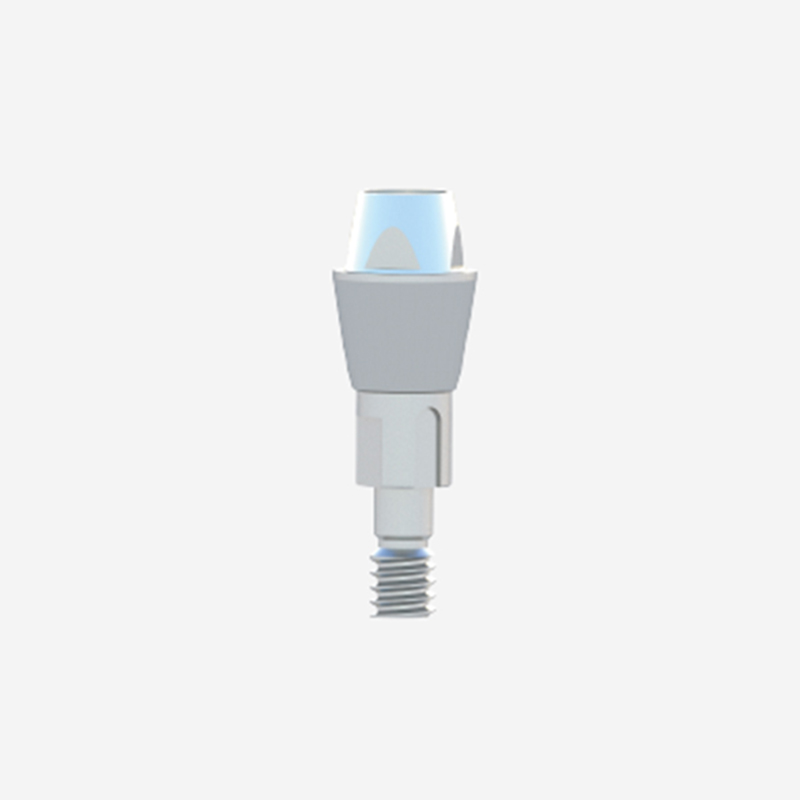
The true engineering brilliance of this system lies in its ability to manipulate geometry. Its primary mechanical duty is establishing a "common path of insertion." When surgical fixtures are placed at diverging trajectories—one at 0 degrees, another at 15 degrees, and a third at 30 degrees—seating a rigid framework over them is physically impossible. The receiving cylinders in the bridge will collide with the divergent angles.
By attaching specific adapters to each fixture, the restorative platforms are redirected to face the exact same vertical axis. Standardizing this trajectory allows a rigid multi-unit framework to glide smoothly over all implants simultaneously.
Specifically, this unified path of insertion is an absolute prerequisite for achieving a "passive fit." In prosthodontics, a passive fit is non-negotiable. The final dental prosthesis must screw down completely flush onto the platforms without introducing active tension, torque, or bending stress to the underlying bone. Forcefully torquing a bridge onto misaligned posts generates persistent micro-tension. This inevitably leads to crestal bone loss, screw loosening, or catastrophic implant fracture.
Mechanically, the entire ecosystem relies on a highly secure two-screw principle. This separates the surgical connection from the prosthetic connection. The primary abutment screw locks the component permanently into the implant fixture at a high torque value, typically 30 to 35 Ncm. The smaller prosthetic screw secures the dental bridge to the top of the platform. This secondary screw is typically torqued to a lower value, around 15 Ncm. It acts as an intentional mechanical weak point, designed to loosen or fracture before the implant itself is damaged by excessive biting forces.
Patient anatomy unequivocally dictates the surgical treatment plan. This, in turn, determines the specific hardware geometry required for clinical success. Manufacturers produce these components in various configurations to accommodate diverse clinical scenarios. Clinicians must carefully evaluate bone volume and opposing dentition to select the correct orientation.
Feature | Straight Variants | Angulated Variants |
|---|---|---|
Primary Function | Platform elevation & standardization | Trajectory correction & elevation |
Implant Placement Angle | 0 to 10 degrees | 15 to 45 degrees (commonly 17° or 30°) |
Common Application | Anterior maxilla and mandible | Posterior regions avoiding nerves/sinuses |
Restorative Path | Maintains original surgical axis | Redirects axis for total parallelism |
Straight variants are deployed when the surgical fixture is placed in a relatively vertical orientation within the alveolar ridge. Since no trajectory correction is necessary, their primary role is platform elevation. They effectively raise the connection point to the tissue level.
In contrast, angulated versions become absolutely indispensable when anatomical limitations dictate intentional implant tilting. Oral surgeons frequently tilt posterior implants to safely bypass delicate structures like the sinus cavity or the inferior alveolar nerve. Standard industry angles include 17-degree and 30-degree options machined from high-strength Grade 5 Titanium alloy. If a posterior implant is angled 30 degrees distally to avoid a nerve canal, securing a 30-degree adapter onto it will redirect the restorative platform perfectly straight upward.
The evolution of full-arch immediate loading concepts has completely revolutionized edentulous patient care. However, these life-changing clinical protocols would be biomechanically unfeasible without specialized abutment systems.
When a patient receives a Full Arch Abutment setup, the final prosthesis must withstand immense, repetitive dynamic mastication forces. This cross-arch system evenly distributes massive chewing loads across all splinted implants. Converting individual implants into a single rigid unit neutralizes stress concentrations. This drastically reduces the risk of mechanical failure.
In addition to superior load distribution, this approach offers profound surgical advantages. Historically, severe posterior bone resorption required invasive, painful sinus lifts or block grafts. By intentionally tilting posterior implants into existing dense anterior bone and using angulated adapters to correct the trajectory, oral surgeons can bypass bone grafting entirely. The rigid cross-arch stabilization minimizes micro-movements during the critical healing phase, allowing clinicians to immediately load a provisional bridge on the exact day of surgery.
Understanding the precise clinical parameters for these components ensures predictable restorative outcomes. Selecting the right hardware requires a systematic approach.
Step 1: Analyze the Trajectory. Evaluate the 3D CBCT scan. If the surgical fixture is placed between 0 and 10 degrees, select a straight component. If the divergence exceeds 15 degrees, an angulated component is mandatory to achieve parallelism.
Step 2: Determine Collar Height. Measure the soft tissue thickness. These components come in varying gingival collar heights, typically ranging from 1.5mm to 4.5mm. The goal is to select a height that places the restorative platform exactly 1mm to 1.5mm above the gingival margin for optimal cleanability.
Step 3: Verify Connection Compatibility. You must ensure the chosen Implant Abutment features the exact connection geometry required for the specific surgical fixture. Whether dealing with an internal hex, a conical connection, or a tri-channel interface, an exact micromechanical match is critical to prevent bacterial micro-leakage.
This abutment is not an isolated piece of hardware. It operates as the foundation of a comprehensive restorative ecosystem. Successfully transferring the clinical reality of the patient's mouth to the dental laboratory requires a highly specific network of supporting parts. Utilizing a premium Implant Accessory is critical for maintaining absolute precision throughout the digital or analog workflow.
Healing Caps: Scewed directly onto the platform immediately following placement. They protect the delicate internal threads from debris and help sculpt the surrounding gingival tissue during the healing phase.
Impression Copings: Utilized in traditional analog workflows. They capture and transfer exact three-dimensional spatial coordinates to the dental lab for pouring accurate stone models.
Scan Bodies: Essential for modern digital dentistry. These PEEK or titanium markers are scanned intraorally. They communicate the exact position and orientation of the platforms to the CAD/CAM software.
Titanium Cylinders: Precision-machined metal sleeves permanently embedded into the final zirconia or acrylic bridge. The prosthetic screws pass directly through these cylinders to anchor the teeth.
While technically possible, it is rarely executed in clinical practice. These components lack the anti-rotational features necessary for a single crown. They are specifically engineered to connect multiple fixtures together to support a splinted, rigid framework. For a single missing tooth, a standard custom or stock abutment remains the standard of care.
A custom abutment is digitally designed and milled specifically for the unique gingival contours of one individual tooth, ensuring perfect soft tissue support. An MUA is a standardized, prefabricated component designed to create a uniform, flat, and parallel platform across multiple implants.
Torque values fluctuate depending on the specific manufacturer. Generally, the core component itself is torqued directly into the surgical fixture at high values ranging from 15 to 35 Ncm. The smaller prosthetic screw, which anchors the bridge to the top platform, is typically torqued to a lower value, usually around 15 Ncm. Always verify the manufacturer's specific Instructions for Use.
Screw-retained bridges are easily retrievable by a dentist for routine cleaning or repair without damaging the prosthesis. More importantly, they completely eliminate the severe risk of excess dental cement becoming trapped beneath the gum line. Hidden cement is a primary catalyst for peri-implantitis.
These adapters are highly specific to the internal or external connection type of the underlying surgical fixture. You cannot thread a generic component into just any implant. High-quality third-party manufacturers produce precision-engineered variants strictly designed to be compatible with major implant systems, ensuring a perfect mechanical seal.
When machined from premium aerospace-grade Grade 5 Titanium alloy, these components possess immense tensile strength. With proper patient oral hygiene, routine clinical maintenance, and a perfectly passive prosthetic fit, they are designed to last for decades, often outlasting the prosthetic teeth attached to them.
Yes. While screw-retained systems eliminate cement-induced peri-implantitis, biological complications can still arise from poor patient oral hygiene or inadequate prosthetic design. If the bridge is designed without proper hygiene access, plaque accumulation around the titanium collars can lead to inflammation and subsequent bone loss.
Ready to elevate your clinical workflows and deliver predictable full-arch restorations? Selecting the exact right geometry, collar height, and connection type is the difference between a frustrating delivery and a perfectly passive fit. Evaluate your upcoming complex cases and explore the precision-milled catalog at Lezylab to find the exact components tailored to your specific surgical requirements.


